
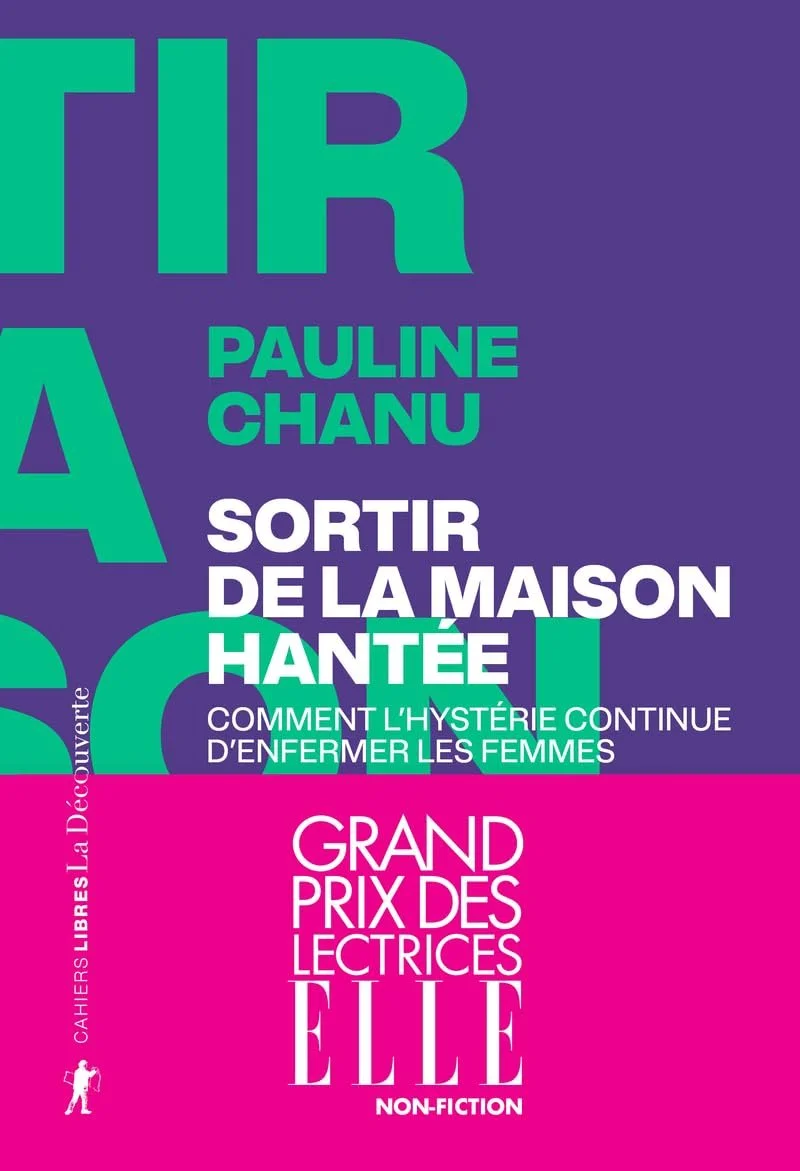
THE hysteria trap: how hysteria is still used to stigmatize women
Pauline Chanu
La Découverte, 368 pages, 2026
*** Winner of the ELLE Reader's Prize 2026***
Why you should look at it:
√ An enlightening investigation into the history of a female pathology
√ Rigorously researched and grounded in contemporary feminist issues
√ A thought provoking invitation to interrogate renewed forms of female subjugation
Blanche Wittman walks into a room at the Salpêtrière Hospital, facing a line of men. Under neurologist Jean-Martin Charcot’s hypnotic spell, she adopts bizarre postures then starts convulsing. It is 1882 and Blanche is known as the “queen of hysterics.” By 1980, hysteria is no longer listed as a disorder in the DSM (Diagnostic and Statistical Manual of Mental Disorders). Yet, as Pauline Chanu demonstrates with brio, it continues to permeate public discourse. Behind the supposedly obsolete fiction of female hysteria lies a system that remains at work: one that, yesterday as well as today, labels women as mad in order to silence them more effectively.
With rigor and tenacity, Chanu tracks down hysteria wherever it still survives: in hospitals, police stations, and courts , but also in our imagination. Although removed from psychiatric classifications, she discovers for example that hysteria is still routinely invoked in the defense of perpetrators of domestic violence. To better highlight the disturbing persistence of this so-called pathology that establishes a link between a woman’s brains and her uterus, Chanu digs through archives and testimonies, interviewing historians, lawyers, and psychoanalysts, revisiting recent legal cases and bringing to light the voices of women buried beneath medical diagnoses from female authors (Sylvia Plath, Virginia Woolf) to renown artists (Camille Claudel, Niki de Saint Phalle, and Marilyn Monroe).
The Hysteria Trap reminds us that while hysteria as a disease does not exist, the symptoms it encompasses do. An illuminating read for anyone concerned with gender-based, medical, or institutional violence.
Pauline Chanu is a documentary filmmaker. For France Culture, she created the radio series Les Fantômes de l'hystérie: Histoire d'une parole confisquée; Sylvia Plath, la vie comme un mauvais rêve and Féminicides : la guerre mondiale contre les femmes. The Hysteria Trap is her first book.