
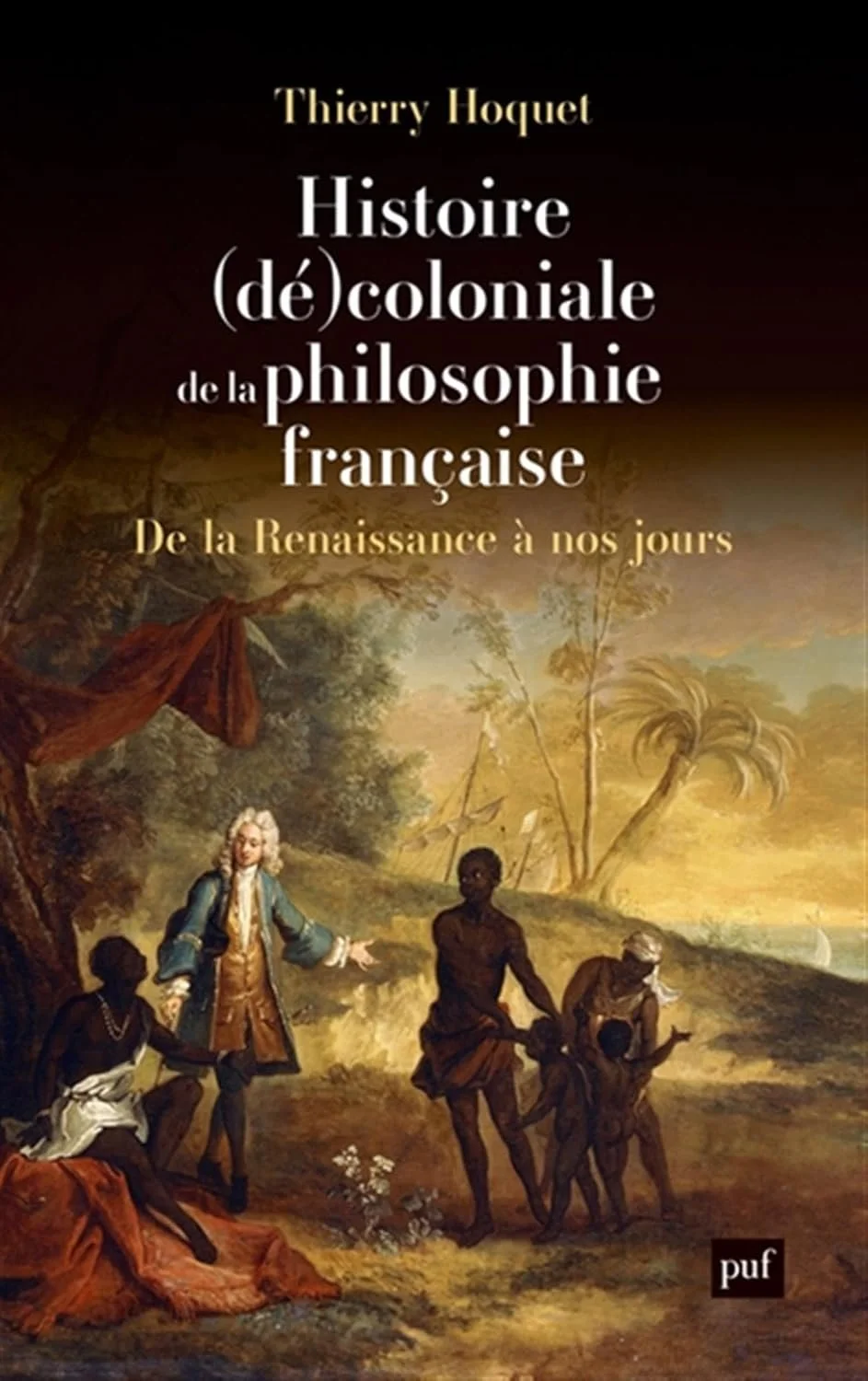
(DE)COLONIAL HISTORY OF FRENCH PHILOSOPHY: FROM THE RENAISSANCE TO THE PRESENT
Thierry Hoquet
PUF, 320 pages, 2025
Why you should take a look at it:
√ A novel origin story of French philosophy
√ A comprehensive narrative that brings both complexity and clarity to the intersection of philosophy, history, and colonization
√ A rediscovery of voices and perspectives long ignored by traditional historiography
Was there a French philosopher who protested against the conquest of Algiers in 1830? Thierry Hoquet could not come up with an immediate response; that is, until he revisited the French philosophical corpus, keeping in mind Edward Said’s famous hypothesis that European culture and colonialism are deeply intertwined.
Hoquet proposes that French philosophy did not begin with Descartes’ “I think, therefore I am” in the 1600s but rather with Montaigne’s chapter “On the Cannibals” in his Essays (1580). The encounter with peoples of the New World (e.g., the Tupinambás of Brazil, the Hurons of Canada) posed from the outset epistemological and moral challenges. Skillfully cross-referencing historical events with philosophical texts, Hoquet reconstructs the religious debates surrounding the Code Noir, the silence of Enlightenment thinkers on the slave trade, the Algerian Question, and the reconfiguration of French philosophy around genocide, decolonization, and the Cold War.
For Hoquet, (de)colonizing French philosophy means decompartmentalizing it and, following in the footsteps of France’s colonial history, the twists and turns through which the voices of its non-European “others” were heard in the French language, producing dissonant discourses.
Hoquet does not seek to create a gallery of moral portraits, since there is no author, no thinker who is the absolute guide one can follow without reservation. Rather, he understands that philosophy—like history—is riddled with contradictions. Engaging less in a process of judgment and elimination than of rereading and adding, he revisits major figures while also, significantly, bringing forth another body of work by lesser-known thinkers.
In this stimulating book, Hoquet redraws the contours of French philosophy with the intention of creating a more complex space informed by both the critical legacy of the Enlightenment and contemporary decolonial studies.
Thierry Hoquet is a Professor of Philosophie of Sciences, Université Paris Nanterre. After working on natural history during the Age of Enlightenment, he turned his attention to issues of gender and race at the intersection of biology and society, from Darwin to the present. His other recent works are of Le Nouvel Esprit biologique (PUF, 2022) and Les Presque-Humains: Mutants, Cyborgs, Robots, Zombies...et nous (Éditions du Seuil, 2021).