
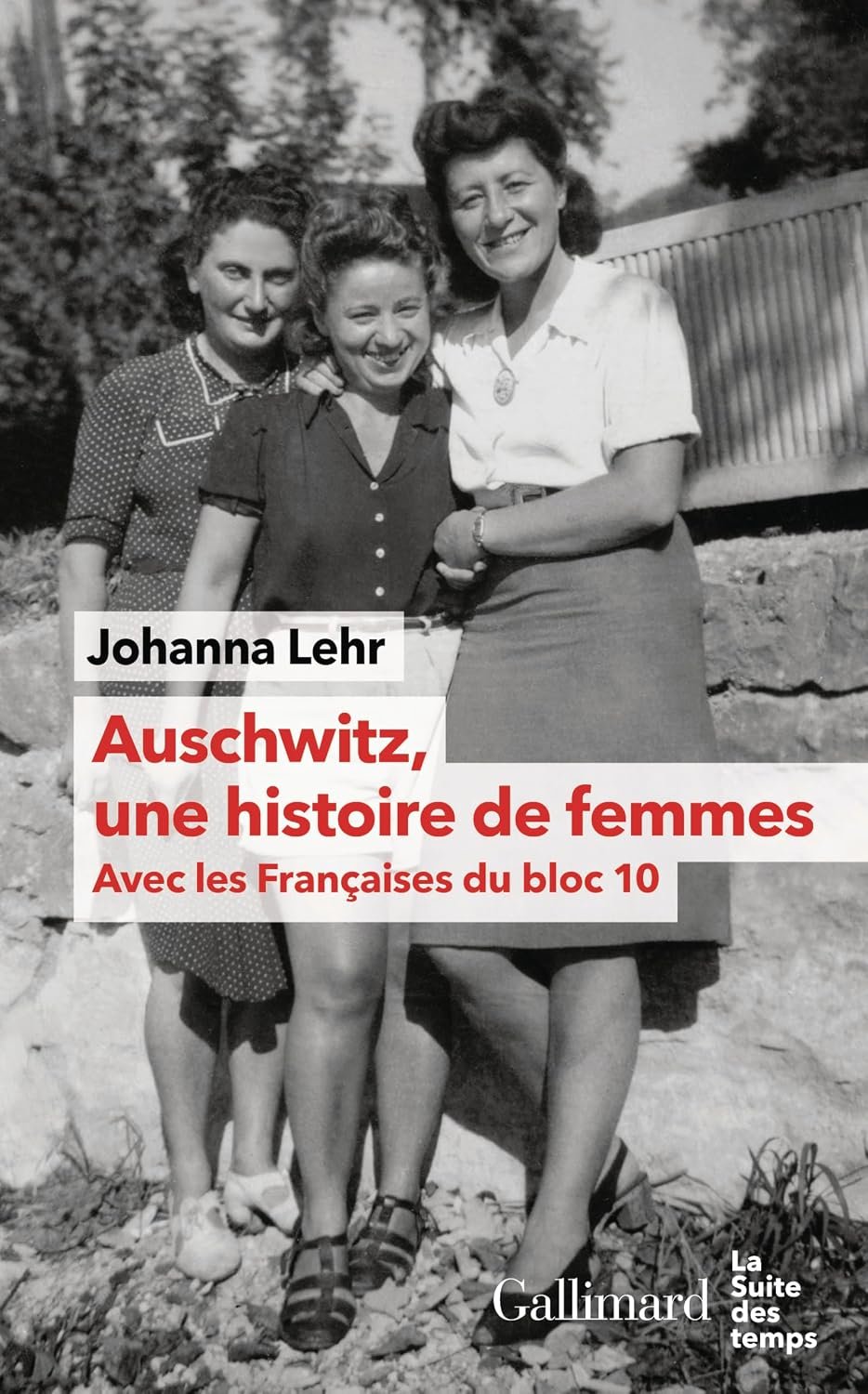
auschwitz, a women’s history
Johanna Lehr
Gallimard, 240 pages, 2026
Why you should look at it:
√ A pioneering work that redefines our view of Holocaust history through a female lens
√ An immersive, unflinching, and comprehensive narrative
√ Blends rigorous historical research with psychological insights into women's trauma
Auschwitz, a Women’s History delivers a groundbreaking, gendered perspective on the Holocaust by uncovering the forgotten fate of the fifty-five Jewish women of Convoy 58 deported from France on July 31, 1943. Upon their arrival at Auschwitz-Birkenau, they were selected for internment in Block 10 and subjected to horrific sterilization experiments.
While Hans-Joachim Lang’s 2011 book, The Women of Block 10, shed light on the operations of this experimental facility, the identities and life stories of the women who were detained there remained largely unknown. Hailing from various European countries, many of these deportees had disappeared from accounts of the Holocaust due to a lack of testimonies and research dedicated to their history.
Johanna Lehr’s research fills this gap. The author, an historian as well as a clinical psychologist, has identified thirty-four of the fifty-five women in the convoy and retraces their life stories before, during, and after their deportation. Lehr utilizes her dual background in history and clinical psychology to explore the complex psychological and intimacy issues faced by those who survived.
Drawing on extensive research in French, German and international archives, as well as previously unpublished testimonies, Auschwitz, a Women’s History highlights the unique nature of the experience endured by these deportees. Targeted as Jews, they also faced a highly specific form of trauma designed to attack and violate their bodies as women.
Johanna Lehr is a clinical psychologist and a historian, an expert in the role of women during the Shoah. She has published several works, including La Thora dans la cité: l'émergence d'un nouveau judaïsme religieux après la Seconde Guerre mondiale (Le Bord de l’eau, 2013), De l'école au maquis : la Résistance juive en France (Vendémiaire, 2014) and Au nom de la loi (Gallimard, 2024).